
 Back
Back 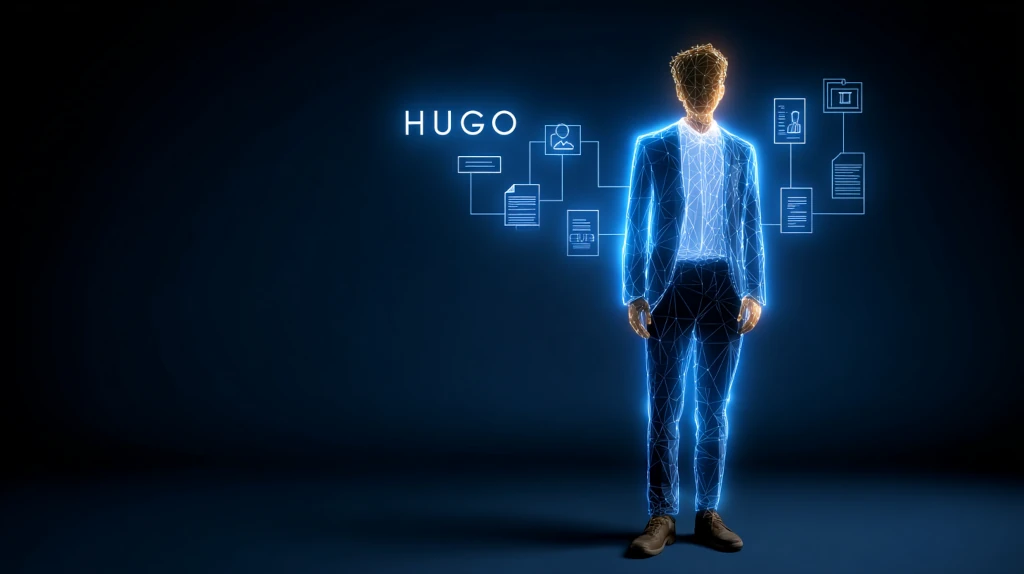
The Problem
AI is transforming the way businesses interact with customers. LLMs can summarise conversations, draft emails, analyse requests, and answer questions with remarkable fluency. Yet for European companies, adopting AI is about more than choosing the right model.
Data sovereignty, GDPR compliance, and maintaining control over sensitive business information are fundamental requirements. Customer records, support histories, contracts, and internal knowledge cannot simply be sent to arbitrary AI services without carefully considering where data is processed, how it is protected, and who ultimately remains in control.
At the same time, modern AI applications need access to live business data. A customer support agent is only valuable if it can retrieve accurate customer information, analyse recent interactions, and help draft responses based on the latest data — not on what the LLN remembers from its training.
This creates an engineering challenge: How do we combine the reasoning capabilities of modern LLMs with trusted business data while preserving security and data sovereignty?
Although HUGO is still an experiment, it has become an excellent vehicle for exploring this question. Rather than building another chatbot, we set out to design a tool-calling AI agent that interacts with business systems through controlled, parameterised functions. Along the way, the project has provided valuable insights into how reliable, privacy-conscious AI agents can be designed for real-world enterprise environments.
Meet HUGO
Our solution HUGO is an experimental AI customer support agent developed by samlinux development - the Boutique Studio. While its current capabilities focus on customer lookup, analysis, and conversation assistance, its primary purpose is to explore how enterprise AI agents can be built securely, transparently, and in line with European requirements.
From the beginning, we designed HUGO around a few core principles:
Built with European AI Infrastructure
HUGO runs in our own controlled infrastructure, giving us full control over the application layer and customer data. For AI inference, we currently use Mistral AI and Berget AI — both European providers that align with our goal of keeping AI workloads within Europe.
Secure Authentication
Users authenticate using Internet Identity, the decentralised authentication system of the Internet Computer. Every conversation is associated with the user’s Internet Identity principal, providing a secure identity without relying on traditional passwords while also connecting HUGO to the broader vision of verifiable applications on the Internet Computer.
Persistent Conversations and AI Observability
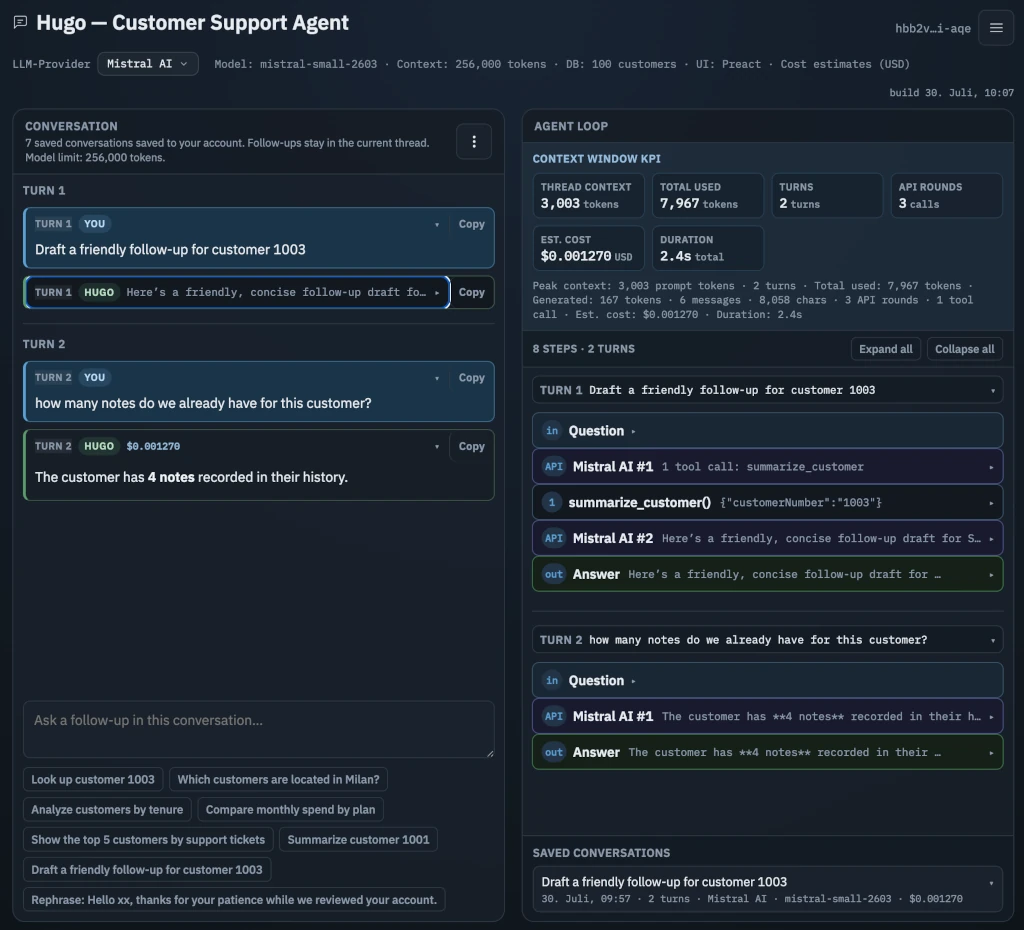
HUGO maintains persistent conversation threads, allowing users to continue previous discussions while securely isolating each conversation through Internet Identity.
Beyond the chat history, HUGO captures operational metadata such as conversation context, number of turns, execution time, token usage, inference costs, and the complete sequence of tool calls and model interactions. These insights help developers optimise the agent, understand its behaviour, and analyse AI usage over time.
We believe this level of transparency will become an essential part of enterprise AI. As regulations such as the EU AI Act increasingly emphasise traceability and logging, AI observability is evolving from a useful development feature into a key architectural principle for building trustworthy AI systems.
A Growing Customer Knowledge Base
Today, HUGO operates on a demonstration dataset containing one hundred customer records. Each customer can be enriched with structured information, notes, and additional business context, allowing the agent to answer increasingly realistic support questions while always retrieving information through controlled business tools rather than relying on model memory.
More Than a Demo
HUGO is not intended to become a standalone customer support product. Instead, it serves as a reference architecture for integrating AI agents into enterprise applications.
Most organisations already have the data an AI agent needs — customer records, support tickets, documents, ERP systems, CRMs, or internal knowledge bases. The real challenge is connecting these systems securely while keeping humans in control.
HUGO demonstrates how an LLM can orchestrate existing business systems through deterministic tools, persistent conversations, and complete AI observability. The same architectural principles can be applied to sales, service, project management, document processing, or virtually any workflow where people interact with structured business data.
As a Boutique AI Studio, we see HUGO as the first of many specialised AI agents. Every organisation has unique processes, data sources, and compliance requirements. Rather than delivering one-size-fits-all AI solutions, we work with companies to design agents that fit their business, integrate with their existing systems, and respect European standards for privacy and data sovereignty.
If you’re exploring how AI agents could support your organisation, we’d love to discuss your use case. HUGO may be an experiment — but the architectural principles behind it are ready for real-world applications.
See HUGO in Action
HUGO is no longer just a concept — it is running and ready to interact.
While it currently operates on a demonstration dataset of one hundred customers, it already showcases the core architectural principles behind trustworthy enterprise AI: secure authentication, tool calling, persistent conversations, AI observability, and European AI infrastructure.
To better illustrate how HUGO works, we’ve included a short demonstration video that walks through a complete interaction — from login, customer lookup and tool execution to drafting a customer response.
Although HUGO is an experiment, the ideas behind it are directly applicable to real business systems. Whether your data lives in a CRM, ERP, ticketing system, or custom application, the same architectural approach can be used to build AI agents that work with live business data instead of relying on assumptions.
HUGO is our public AI engineering laboratory. We use it to experiment with new architectures, evaluate European AI models, explore trustworthy AI patterns, and share what we learn along the way.
This is exactly the type of enterprise AI we are exploring at samlinux development — the Boutique AI Studio.