
 Back
Back 
Every few months, a new generation of AI models pushes the boundaries of what’s possible. OpenAI’s GPT-5.6, Anthropic’s latest Claude models, Google’s Gemini, xAI’s Grok, Meta’s Llama, and Alibaba’s Qwen continue to raise the bar with stronger reasoning, longer context windows, better coding capabilities, and increasingly sophisticated multimodal understanding. Yet, despite these remarkable advances, one fundamental question remains largely unanswered:
Can we trust the information the AI is using?
We tend to assume that as artificial intelligence scales, reliability naturally follows — that larger parameters and faster architectures will inherently eliminate error. But, scale is not a proxy for truth. Better models do not automatically produce reliable answers. The core bottleneck of the AI era isn't parameter count or processing speed; the real challenge is trustworthy knowledge. Until we solve how knowledge is verified, grounded, and maintained, even the most sophisticated systems remain brilliantly unreliable.
AI Is Only as Good as Its Data
The Engine versus The Archive
To understand why better models do not automatically produce more trustworthy answers, we first need to separate two concepts that are often conflated: reasoning capability and knowledge integrity.
Modern Large Language Models (LLM) are, at their core, reasoning engines. They excel at recognising patterns, understanding context, drawing connections, and synthesising complex information. But, like any engine, they require fuel.
When operating solely on their pre-trained parameters, an LLM does not retrieve verified facts from a trusted source. Instead, it predicts the most probable next token based on statistical patterns learned during training. This enables remarkably fluent and often insightful responses — but it does not guarantee that those responses are factually correct, up to date, or verifiable.
Knowledge sources, by contrast, serve as the archive of truth. Whether they consist of curated enterprise documentation, scientific publications, regulatory databases, or verified public records, they provide explicit information that can be traced back to its origin and, ideally, independently verified.
Improving a model’s reasoning capabilities makes it a more capable thinker, but it does not automatically improve the quality of the knowledge it relies upon. A brilliant model can still produce misleading answers if its underlying information is incomplete, outdated, or has been silently altered.
Trustworthiness, therefore, is not a property of the engine — it is a property of the knowledge.
Retrieval-Augmented Generation (RAG) Solves One Problem
To overcome one of the biggest limitations of LLMs — their reliance on static training data — we don’t necessarily need a smarter reasoning engine. We need a better way to provide it with relevant, up-to-date knowledge. This is precisely what RAG is designed to do.
Rather than relying solely on what the model learned during training, RAG turns every user query into something closer to an open-book exam.
When a user asks a question, the system typically performs three steps:
- Retrieve – Obtain relevant information from external knowledge sources, such as vector databases, enterprise documents, APIs, databases, technical manuals, or internal business systems.
- Augment – Inject the retrieved content into the model’s context window, providing additional information alongside the user’s prompt.
- Generate – Use the LLM’s reasoning capabilities to interpret the retrieved and augmented information and produce a coherent, context-aware response.
In essence, RAG fundamentally separates knowledge from reasoning. The knowledge can evolve independently of the model itself, allowing organisations to update documentation, policies, or product information without retraining the underlying LLM.
For this reason, RAG has become the de facto architecture for enterprise AI assistants, customer support systems, internal knowledge bases, and domain-specific copilots.
However, while RAG significantly improves relevance and freshness, it does not guarantee trustworthiness. It simply gives the model access to external information.
This immediately raises a more fundamental question:
How do we know that the retrieved information is authentic?
If the underlying knowledge base contains outdated documentation, incorrect policies, manipulated records, or AI-generated content that was never verified, the LLM has no way of detecting that. It will faithfully reason over whatever information it receives.
The result is not necessarily a hallucinating model — it is a model confidently explaining unreliable information.
In other words:
RAG reduces hallucinations caused by missing knowledge, but it cannot prevent hallucinations caused by untrustworthy knowledge.
This marks a fundamental shift in AI architecture.
Yesterday’s challenge was model capability — building systems that could reason effectively.
Today’s challenge is knowledge provenance — understanding where information comes from, who created it, whether it has changed, and whether its integrity can be independently verified.
Connecting an LLM to a database is therefore only the beginning. Building trustworthy AI requires confidence not only in the model, but also in the origin, integrity, governance, and verifiability of the knowledge it retrieves.
The Missing Layer: Trust
Modern AI systems have become remarkably good at retrieving and reasoning over information. Whether knowledge comes from documents, databases, APIs, or enterprise applications, today’s AI can access more information than ever before.
Retrieval tells us what information is relevant. It does not tell us whether that information is authentic, up-to-date, or has been silently modified.
For organisations, this raises important questions:
- Who created the information?
- Has it changed since it was approved?
- Which version is the AI using?
- Can its integrity be independently verified?
Without clear answers, even the most advanced AI model can confidently generate answers based on unreliable information.
This is the missing layer in today’s AI architectures: trust.
The solution is not another generation of larger language models. It is a trust layer that accompanies every piece of knowledge with verifiable metadata — its origin, version, integrity, and history. Before AI can produce trustworthy answers, the knowledge it consumes must itself be trustworthy.
In other words, the next evolution of AI is not just better reasoning, but verifiable knowledge.
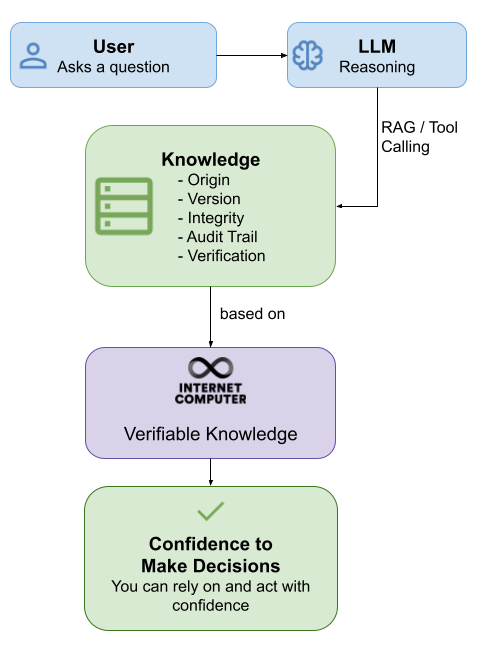
Building Verifiable Knowledge with the Internet Computer
If trustworthy AI requires trustworthy knowledge, the next question is obvious:
How can knowledge become verifiable?
A trustworthy knowledge system should do more than simply store documents. It should preserve their origin, record their evolution, and provide cryptographic evidence that published information has not been silently altered.
The Internet Computer (ICP) is one of the few computing platforms that allows applications themselves — not just the infrastructure — to expose cryptographically verifiable state. This makes it possible to build knowledge systems whose integrity can be independently verified. By combining tamper-evident storage with cryptographic verification and certified application state, it enables applications to publish knowledge that can be independently verified instead of being trusted solely because it resides in a database.
Soveri Content is one example of how this architectural approach can be implemented. Rather than focusing only on content management, it treats every published page as a verifiable knowledge asset.
When content is published:
- a cryptographic hash is generated,
- the publication is recorded in an ICRC-3 audit trail,
- every content change creates a new verifiable version,
- and the integrity of the published content can be independently verified.
An ICRC-3 audit trail is a standardised, tamper-evident block log on the Internet Computer.
This transforms traditional content publishing into a verifiable knowledge pipeline. Whether an AI system retrieves information through RAG, direct APIs, or tool calls, it is no longer consuming anonymous documents — it is consuming knowledge with a transparent and cryptographically verifiable history.
The goal extends beyond building a better CMS. It is about creating a trusted knowledge foundation that future AI systems can rely upon with confidence.
In the coming AI era, competitive advantage will not belong only to organisations with the most powerful models, but to those that can provide the most trustworthy knowledge.